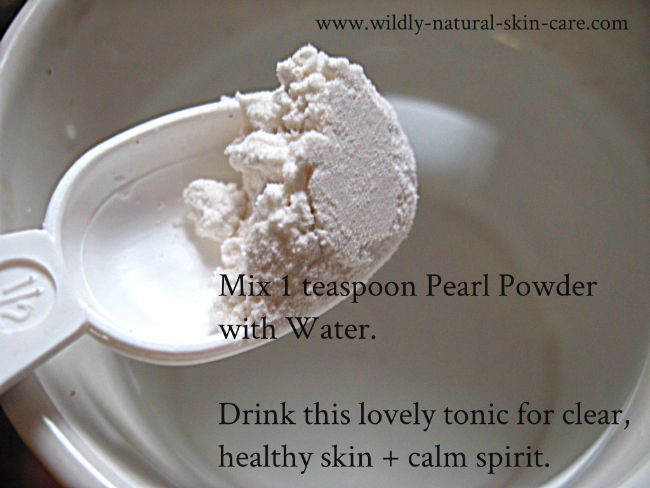
How to Use Pearl Powder for Best Results
Pearl Powder is an anti-aging, refining, make your skin glow powder that you will want to try. Click here if you didn’t get a chance to read 3 Gorgeous Ways Pearl Powder Can Transform Your…
Pearl Powder is an anti-aging, refining, make your skin glow powder that you will want to try. Click here if you didn’t get a chance to read 3 Gorgeous Ways Pearl Powder Can Transform Your…
I was talking with a friend recently and he was sharing about some skin concerns he is having. A very critical piece he’s missing is any sort of skin care ritual- rather he just wakes…
These shops are all natural, though I always recommend reading the ingredient list and asking questions when you have them. My criteria for choosing these shops is:
Here are some favorite, natural places to buy skin, body, and hair care.
If you love making your own products or want the highest quality from reputable sources, this is the spot.
Best for: bulk herbs, oils, and more

______________________________________________________

You can read my post on MM here to get the background on how I found them and how amazing their products are! MORROCCO METHOD INT’L has provided the world’s finest in wild-crafted, raw, vegan and gluten-free hair care for more than 40 years. Each wild-crafted product is carefully designed to both detoxify and nourish your hair and body. Begin detoxing your hair today and enjoy beautiful, naturally luxurious hair with Morrocco Method products.
Everything you need for clean, vibrant, voluminous, healthy hair is here. For real.
______________________________________________

Inspired by the sensual and the natural, Venus in Violet is a handcrafted boutique perfumery and natural oils company. The flagship product Tantrika is a natural perfume oil that is multi-use: use on your hair, nails, skin, and as a gorgeous perfume to attract the sensual.
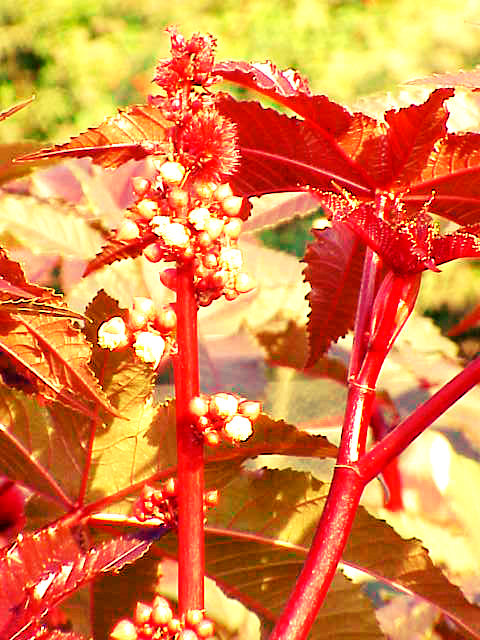
Sex. Body. Juiciness. Love. Oils are the trees’ nut juice. Seriously. The pressing of the oils nuts and seeds is what allows the oil to come out. They are fatty, plump, silky, and have and…
Many people write to me asking for advice about skin conditions. This is tough, because I will need to know much more about what is going on to help. You know your skin best, living…

Vitamin C’s use in skin care is becoming better known, particularly with topical uses. I like to experiment with skin care and so gave vitamin C a try. Honestly, it irritated my skin a bit!…
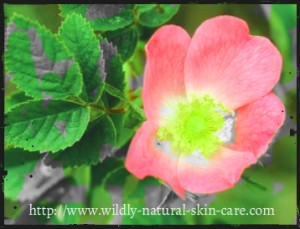
Learning how to make rose oil using the simplers’ method is quick and effective.
Before we get into it though, read the article on the best oils for your skin type to figure out the best carrier oil for your unique skin type or condition.
To make your rose oil the most potent it can be, you should know which type is best for you.
With that checked out, let’s begin!!
If you have access to fresh rose petals, you are abundantly blessed! Allow them to dry for 12 to 24 hours so your batch doesn’t develop mold.
Note that rose oil discussed here is the herbal-infused oil and is different than rose essential oil. Making essential oils requires more sophisticated technology and loads of plant material. Herbal-infused oils are simple to make and are quite medicinal in nature. The aroma is generally much more gentle than that of an essential oil.
The best place to buy rose petals and all other ingredients for this recipe is here.
Work with intention, allowing space in your busy life to be present. It is fitting to say a short blessing or prayer that the final product is an effective healer.
Rosa centifolia and Rosa damascena are the most commonly available Roses and are well-suited for herbal skin care.
1) Fill a clean jar ¾ full with freshly dried or dry rose petals and buds. You can break up and bruise the petals gently.
2) Fill the jar to the top with carrier oil of choice. I use extra virgin olive oil most commonly, though sweet almond or coconut (melted) would work well.
3) Cap and shake to distribute the herb.
4) Label with the herb used, where it is from, the oil used, quantities of each, the date and the method of preparation.
5) Allow the jar to sit in a cool, dark place, shaking daily.
6) At 4 weeks/28 days/1 moon cycle, strain the oil into a clean bowl, squeezing the herb to get every drop. I find it helpful to use an old t-shirt or cheesecloth to catch the herb. Then lift the t-shirt with herb in it and squeeze that.
7) The strained liquid is your finished oil. Essential oil can be added or it can be left as is. It will have the sweet scent of roses, though it may be light. You could always make a double or triple infusion, where you would use the filtered herbal oil as the carrier oil for a fresh batch of rose petals.
Rose Oil can be used as any other herbal oil, for cosmetic, massage and medicinal purposes.
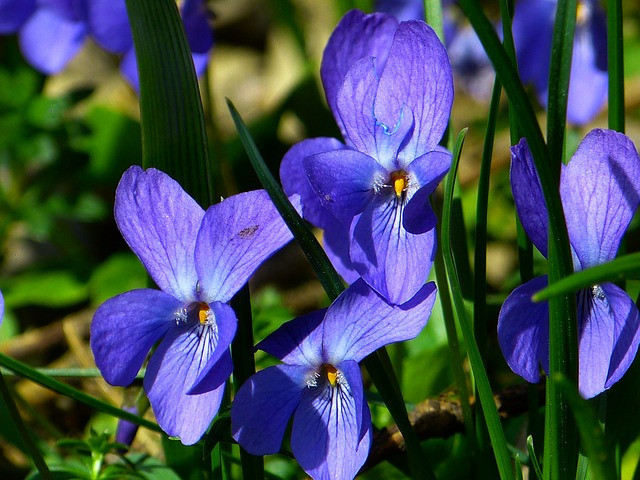 The violet is an especially medicinal little plant and making violet flower oil is literally magic. I went searching for these tiny beautiful flowers yesterday to make one my herbal oils that I often rave about. Though it took me three hours to find a healthy patch, once amongst the violets, it was all worth it.
Making herbal oils is quite easy, yet, if you haven’t made one there are several points to keep in mind. You can read the full details on making herbal oils here. Basically an herbal oil or an herbal-infused oil is macerating (soaking) herbal material (can be flowers, leaves, roots, seeds- any plant material) in a carrier oil.
1) Violet flowers are especially lovely, yet the leaves are quite medicinal as well. For a blend, you could do 75% flowers and 25% leaves or some other ratio.
2) It is great to let the flowers wilt overnight to avoid excess moisture in your finished oil. Water will make the oil get moldy and not very useful.
3) There are several methods to making herbal oils; I’ve detailed the stove-top method below.
4) Wildcrafting, especially in urban environments, comes with special considerations. Make sure to find a clean area: away from traffic, dog paths or chemically sprayed areas. It can be tricky if you don’t have a yard!
What you will need:
~Violet flowers and leaves- fill the jar to a light pack- if you can’t harvest fresh violet, you can purchase it here
~Sweet almond oil- I buy my oils here
1. Collect violet flowers after the morning dew and before any strong sun hits them. You want the flowers to be fresh, vibrant and intact. Lightly pack a jar the size of the amount of finished oil you would like. For example, I filled up a quart jar with flowers and some leaves too.
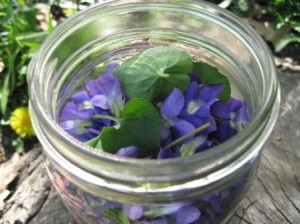
2. Allow the flowers to wilt overnight to evaporate some moisture.
3. Now time to make the oil. Set up a double boiler, which is basically a pan with water in which you will place either a pot or a heatproof glass jar.
4. Break up the flowers with a mortar and pestle and place in the jar or pot.
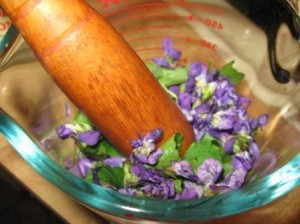
5. Cover with carrier oil of choice, fill to just above the top of the herbs. I used sweet almond oil for this infusion.
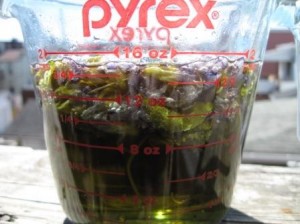
6. Place the jar in the water and turn on the fire.
7. Using a chopstick, continually check the temperature of the oil and agitate the herbs. You want the oil to be hot, but not burning. If it is burning your skin, turn the heat down and/or remove the herb/oil infusion until it gets right below that warm/hot spot.
8. Allow the mix to warm for an hour minimum and as long as four hours.
9. Strain the oil through an old cloth or cheesecloth. If using somewhat fresh herbal material, do not press the oil as that will make the water go into the mix. I just lightly tap the material to release some of the oil but don’t expect to collect it all.
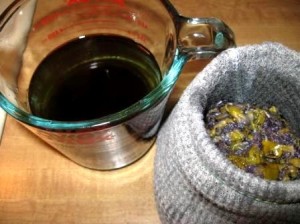
10. If you think there is some water in your mix, allow it to rest and the water will fall to the bottom. You can then decant the upper layer of oil into a new jar.
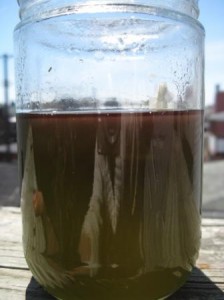
The flower is especially:
~Cooling: making it a prime remedy for heat and inflammation
~Mucilaginous: very soothing and moistening texture, especially suited for dry and irritated conditions, including skin
~Dissolving: violet works with the lymphatic system to break down and move blockages
~Magical: violet is the color and holds the energy of the third eye, ajna, chakra and helps to open up intuition and seeing layers within present reality clearly. It can be used most effectively as an anointing oil for ritual use or before bed for revelatory dreams.
~Heart-Opening: keeping an open heart is a pre-requisite to accessing bliss. Little violet knows a great deal about the heart, remaining vulnerable and tender. Those tender spaces are where love resides.
The oil can be applied medicinally to certain areas or used as abyangha oil. It is perfect by itself but can also be blend. I am going to blend this batch with castor oil for a very detoxifying and healing abyangha oil, to move blood and chi. Here’s an article by herbalist Susun Weed where you can learn more about violet flower.
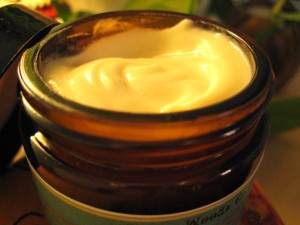
A natural skin cream is a blend of oils and waters that are binded together. The addition of essential oils, extracts and natural preservatives add aesthetic and therapeutic value while increasing shelf life.
Natural skin cream is one of the most challenging preparations to make, as oils and waters repel each other and so an emulsification can be complex. Emulsification involves temperature control of both oil and water phases, getting the blending time just right, and preventing separation from occurring.
A truly natural skin cream can also be hard to find. There are some companies that make them, either using very sanitary operations and no preservatives or natural preservatives, including essential oils. Here are my favorite companies that make truly natural creams:
I choose to avoid chemicals for skin care so I often make my own natural skin creams. There is infinite variety and experimentation- fun, fun, fun! Natural skin creams are great for dry skin- face and whole body- as they are very rich and exquisite. A tiny pinkie-fingerful goes a long way. They are even heavier than straight oils.
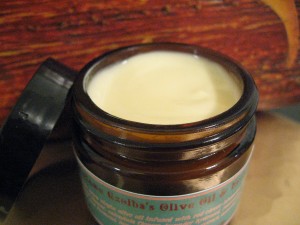
This recipe makes a 19 oz batch, enough to keep you smooth for a long time (and your friends and family). Or you can cut the recipe in half if you like.
Get all of your ingredients for this cream here.
Oil Phase
Extra virgin olive oil (infused with lavender, dandelion flower, red clover flower, yarrow flower and calendula) 6 oz
Coconut oil 2.7 oz
Beeswax 1 oz
Lanolin ½ teaspoon
Water Phase
Borax 1 teaspoon
Rose Water 3 oz
Lavender Hydrosol 4 oz
Optional Ingredients
Leucidal (a natural preservative) 1 tablespoon
Synergy (antioxidant blend) 1 teaspoon
Directions:
Using the double boiler method, melt the oil phase in a Pyrex measuring cups until the oils and fats are completely melted. Allow to sit until the oils begin to solidify again. Meanwhile, turn the heat off and put the water phase into the double boiler in a separate Pyrex cup. When the oils are almost solidified, slowly add the water phase to the oil phase, beating continually with an egg beater. Emulsification is when a cream forms. Be sure to incorporate all the water into the oil.
Lastly, add the essential oils and beat in gently. Pour into clean containers and let thicken.
Purchase all of the the ingredients to make the natural skin cream.
This cream has a natural scent and is a true olive oil cream (olive oil is the main ingredient, not a speck somewhere down the ingredient list!). It is quite rich and heavy and is well suited for very dry skin or used in small amounts. Lanolin is added to make this a rich cream suited for dry skin, babies and the elderly as well as on stubborn dry areas as a therapeutic aid.
Extra virgin olive oil is an effective skin cell regenerator. It is the first pressing of the olive and contains the highest amount of nutrients. It attracts moisture while still allowing the skin to breathe. Madame Czolba’s Olive Oil & Herbs Cream is skin softening and will help to keep the skin supple and youthful.
Coupled with the benefits of extra virgin olive oil are the herbs infused in it. Additionally rosewater and lavender hydrosol are toning and healing.
This rich cream can be used on the face and neck. It has a smooth and creamy texture and is unscented so gentle enough for the most sensitive skin. The cream may take a few minutes to be fully absorbed and only a small amount is needed.
I use natural skin creams much more in the winter. I’ve also gotten some people hooked. By adding extra special ingredients and oils, green tea extract, hydrosols and precious essential oils, to name a few, folks’ skin heals and becomes youthful like never before.
“I love this. It worked great as a protectant and moisturizer in the winter and is light enough to use during the warmer weather too. It kept my face protected from winter wind and it kept it from being too dry in the winter too. I also used it on my hands at bedtime.
It also worked to remove “Gorilla Glue” from my hands. The directions on the Gorilla Glue said to use an emollient.” –Marjie D.
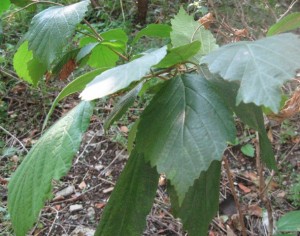 Witch hazel astringent is a pretty well-known folk remedy here in America. It was used by the Native Americans for its tightening, toning, and soothing properties as a decoction.
In the 1800’s it became a popular remedy in the mainstream and has managed to still be a rather common preparation. It is also called witch hazel extract. Being astringent is a property of some plants, particularly those high in tannins or other chemicals. An “astringent” is also used interchangeably with the term toner (that is what this article is about!). An extract is a medicinal tincture of the plant (where a medicinal plant is steeped in a menstruum).
Witch hazel (Hamamelis virginiana) is a native small tree in the northeastern United States. The commonly used medicinal part is the bark of the tree as well as the leaves. The bark contains 31 times more tannins than the leaf extract. If you’d like to make your own witch hazel extract, be sure to use the bark of fallen branches or at least prune the tree and use the bark and leaves from those branches. Taking bark from the trunk (girdling) can kill the tree.
Witch hazel dries and tightens tissues so it works on moist and loose conditions. It is often used for conditions that are inflamed, red, and oily: acne, hemorrhoids, irritated cuts and rashes, dermatitis and itching. It can be used to help dry up poison ivy rashes, diaper rash, bedsores and other oozing, inflamed skin. High in tannins, witch hazel has natural properties that tone and tighten the pores, decrease inflammation, act as an antiseptic and slightly dry oily skin. It is also an antioxidant and radiation-protective. Witch hazel astringent makes a great aftershave and works to dry up pimples.
Witch hazel extract can be found at many pharmacies; however, I have found this to be mostly rubbing alcohol and rather unpleasant. I prefer to purchase witch hazel astringent by the gallon from Mountain Rose Herbs. The witch hazel extract commonly available in the U.S. is a product of steam distillation. The twigs and bark are distilled in vats for 36 hours, then re-heated, condensed and filtered. Alcohol is added to the final product as a preservative. In Europe, a water-alcohol extract is used rather than the distillate.
Witch hazel hydrosol is also commercially available. An astringent can be made from witch hazel simply by tincturing the bark in 40 to 65 percent alcohol (80 to 130 proof). The finished tincture can be diluted with a floral water, like rosewater, to make a less drying, more soothing astringent. Or essential oil can be added for a particular medicinal effect.
Alternatively, a decoction can be made from the leaves and stems and the final “witch hazel water” can be preserved with alcohol. This is desirable when a high amount of tannins is required, since the distillation process actually destroys most of the tannin content.
High quality witch hazel extract is generally 14% alcohol by volume and can be used to extract other herbs. One of the most common ways I make skin toners is by using witch hazel extract as a solvent (called the menstruum), tincturing other skin-loving herbs like lavender, rose, oregano, sage and thyme. To this witch hazel astringent/herbal extract, I’ll add other beneficial ingredients: flower waters, essential oils, glycerin, and aloe vera, depending upon the skin type for which I am formulating.
Witch hazel astringent is a great herbal to have on hand as a toiletry and a first aid item. It acts both cosmetically, in the treatment of acne and pimples, as well as medicinally when working with rashes, blisters and similar conditions. While some commercial preparations are high quality, be aware that many products found commercially are mostly rubbing alcohol and may have little medicinal value.
This rose water recipe embraces the healing properties of just three ingredients. There are many ways to use rose water, from using it to flavor foods and as an ingredient in natural creams.I find this skin toner to be perfect for overheated or even sunburned skin and it smells sooo good you’ll just love it.
Rose water itself is made as part of the distillation process in making rose essential oil. Many pounds of fresh rose petals are needed to yield very small amounts of the essential oil and the rose water (also called the hydrosol). This rose water recipe is made with already prepared rose water.
Even though I wear a natural sunblock and a hat when I am in the sun that my skin will still feel hot and somehow I manage to catch a tan.
All these ingredients can be purchased here.
The aromatherapeutic properties of rose come through in rose water as well. They include alleviating depression, opening the heart chakra and creating peace and calm. Too much sun and heat brings out the crankster in the best of us, yes? It is beautiful to have allies in nature to help bring us back to center and love.
The proportions are flexible here but I’m offering a basic 50 / 50 ratio. Also, this recipe can be increased or decreased depending on how much you want to make. Be sure to keep it refrigerated if you won’t be using right away, as it is water-based. It does have slight natural preservation though.
Ingredients:
Organic rose water 4 ounces
Organic aloe vera gel 4 ounces
Sandalwood essential oil ~30-50 drops
My favorite place to buy all the ingredients for this rose water recipe
Directions:
Mix the rose water and aloe gel together in a measuring cup. Add the essential oil, varying the drops based on your preference for smell. Pour the final mixture into either a spritzer or straight bottle.
To use this, make sure you shake well first as the essential oil will float to the top when it is sitting. It is also good to keep extra in the refrigerator.
A spritzer bottle is a great way to package this toner, as it is easier to use and keeps bacteria out. It also will last longer as it is more efficient in how much you use per application. Just be sure not to spray it in your eyes of course.
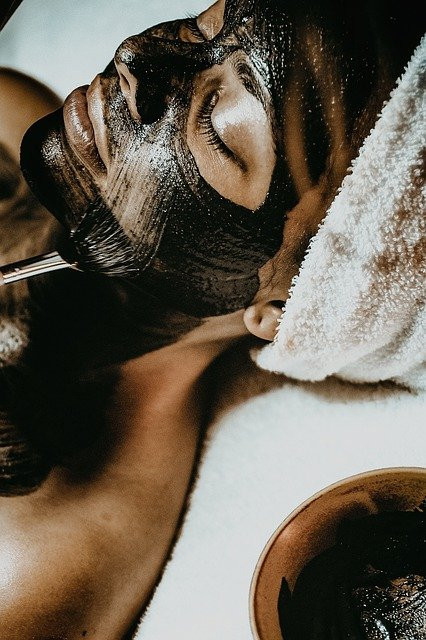 There are so many natural face mask recipes and products that it can be overwhelming!
1) Use what you have on hand. Face masks can be made from common food items: yogurt, milk, vinegar, fruits, vegetables, honey, eggs, oatmeal and flours.
2) What do you have? Here’s a short list on what each is good for. Consult with the chart below to create a mask based on your skin type or condition.
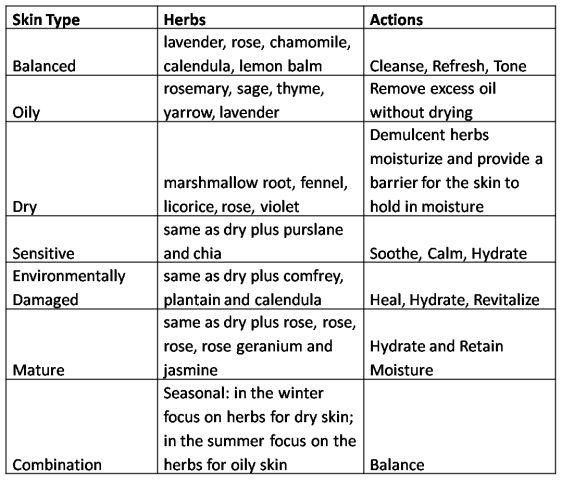
So, now you have the basics to make a natural face mask simply select a few ingredients and experiment with proportion. Mixing a solid (for example, flour or mashed vegetable) and liquid will help to keep it in place. You want to make a pasty texture, something that can be easily applied and will stay on and not drip all over the place!
Generally masks are applied and left on for a few minutes to a half an hour. When I use lemon juice or vinegar, I only keep it on for a few minutes as these can be irritating. You will feel the sting; follow your instinct!
Also refer to the article on homemade exfoliants, for more tips and recipes.
Ingredients:
1 teaspoon Facial oil, olive oil, sunflower seed or almond
1 Egg Yolk
¼ teaspoon Apple cider vinegar
Directions: Beat egg yolk. Add vinegar and oil and mix in. Apply this to the face and leave on for about 10 minutes. Rinse with warm water and finish with a splash of cold water. Spritz with floral water and immediately apply a facial oil.
Use this mask to gently exfoliate and cleanse the skin. Suited for normal, oily and teenage skin.
Ingredients:
1 teaspoon Raw Honey
1/4 Avocado
Directions:
Mash avocado, mix with honey and apply! This is super soothing, moisturizing and nourishing and especially suited to dry and sensitive skin.