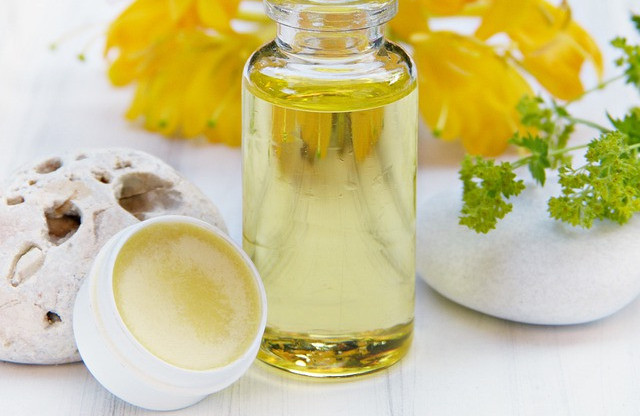
Abyangha is an Ayurvedic practice of daily self-massage with oils. It has so many benefits for the body and spirit, including amplifying skin health and moisture and strengthening the circulatory, nervous and lymphatic systems.
On a more esoteric level, it protects us from negative outer influences and strengthens our natural boundaries and preferences. As you see, the practice of caring for the body includes more than the physical, as “matter” and “spirit” are inextricably connected. When we care for the body, we care for the soul.
Now, I apply oils daily and though it takes effort and a bit of discipline, I am so pleased by the benefits. I have a young son and carving out this self-care ritual is an act of love for myself and also challenges my creative thinking skills.
Here is my daily routine:
I have a yogurt maker that I keep in the bathroom and store my oils in. I plug it in at night so that in the morning the oil is a perfectly warm temperature. This not only feels so good but it also helps the pores to open up and better receive the oils.
How to Apply Abyangha Oils
1) Set your intention. This body care stuff is a healing and sacred act and taking a moment to remind yourself of that is powerful.
2) Start with your feet and legs and massage the abyangha oils up towards your heart. Keep the flow towards the heart for your whole body. Meanwhile, whisper sweet nothings to yourself, about how beautiful, strong and healthy you are and how the oils are doing their job perfectly.
3) Work your way up massaging each part in turn with the same process:
~Belly, hips, thighs and buttocks
~Lower back
~Chest, breasts, neck (don’t forget the back of the neck)
~Out to the arms and hands
~Face and ears (those ears have mad sensors and it’s good to stimulate them!)
4) Take a moment at any part of your body that is in need of extra special healing and love and once again, set your intention that this part of you is healed and operating at full vibrancy (it’s inherent in our DNA you know).
Now you get to let the oil soak in for a while. I make abyangha part of my daily practice (sadhana) and so I take this time to meditate, pray and otherwise revere the sacred. You could also wear a robe and do whatever you do in the morning. The oils will stain clothing so wear something particularly for your abyangha practice. Give it a minimum of 15 minutes soaking time if you can for maximum benefits.
Next you shower and this washes off the excess oils yet leaves your skin moisturized.
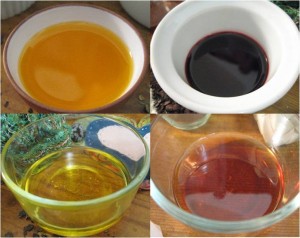
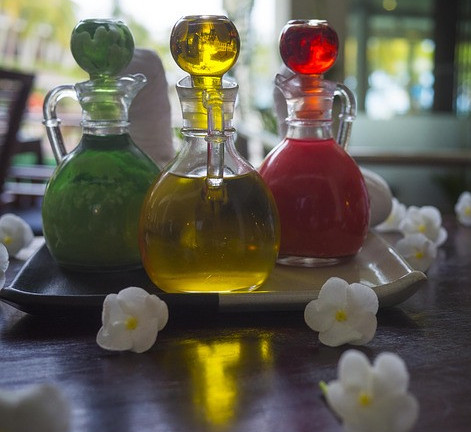
One of the really fun things is creating your own oil blends to suit your skin type, the season and temperature and any current healing needs you may have. A blend that I made recently was designed to be very rich and nourishing to bring my dry and somewhat neglected skin back to vibrancy.
This yellow-green, thick and rich oil goes on very smoothly and feels delightful. Being heavy and warming, it is perfect for “recovering” skin: cold, dry, ashy, uneven tone to restore moisture, pliancy and even tone.
When I first started using this blend, I double dipped applications (morning and evening) and when my skin responded noticeably after only two days, cut back to once per day.
Abyangha is good for everyone, from babies to elders. It is particularly valuable for maintaining youthful skin, as one of the keys to healthy skin is oil which keeps the cells plump.
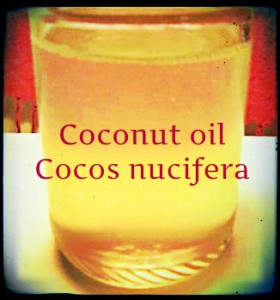
You will read a great deal about coconut oil for skin on this site, because it is one of the oils I use most often. Internally and on the skin, coconut oil is a well-loved and highly useful oil.
I recommend using extra virgin, organic and unrefined coconut oil for skin best results. It has a soft, smooth texture and the deep, distinctive scent of coconuts.
Coconut (Cocos nucifera) thrives in the tropics and is a traditional moisturizer for skin and hair. The oil is extracted from the inner flesh of the coconut and is produced in India, Sri Lanka, Malaysia and Indonesia.
Coconut oil is 90% saturated fat with almost half of that as lauric acid. Lauric acid can kill some bacteria and is antifungal as well, making coconut oil for skin a wonderful antiseptic. Practitioners of Ayurvedic medicine and traditional healers in India use coconut oil as a base for many medicinal preparations for treating skin diseases.
The saturated fat content of coconut oil keeps it as a solid under 76 degrees F and a liquid above that. I find it best to store in an open mouth container so that I can always access it when I want it. I remember when I was first started to make natural products and I made a coconut oil based hair balm. I used a pretty blue glass bottle and mixed it up with some rosemary essential oil. Later I realized it had solidified and I couldn’t use it when I needed it! Ha, lesson learned.
The properties that make coconut oil for skin so useful are:
• It is a “dermal penetration enhancer” meaning that it easily permeates the skin. • A light oil with a slightly drying quality • It is used alone and can be blended with other natural skin care oils and essential oils, used in creams, salves and hair and lip balms. • Contains antiseptic properties
Coconut Oil for Skin Issues Ranging from Burns to Flaky Skin
Coconut oil is an effective burn wound healing agent, allowing for faster healing without complications. It is both an anti-inflammatory and antiseptic.
It is one of the most effective oils for acne, as a cleansing oil or moisturizer.
Coconut oil has been shown to treat Atopic Dermatitis, including infected dermatitis, with a reduction in activity of bacteria, fungi and viruses, including Staphylococcus aureus. For this purpose, apply two times per day for 4 weeks to affected area.
Prevents free radical formation, promotes healing and gives youthful, soft, healthy appearance to the skin. As a general moisturizer, use coconut oil alone. Apply a small amount and dab off excess.
Coconut oil can prevent age spots, wrinkles, and other age blemishes
Soothes wounds, rashes, warts and athlete’s foot
Coconut oil is a moisturizer for mild to moderate xerosis. Xerosis is a common skin condition which basically means dry, rough, scaly and itchy skin. One study showed significant improvement with use of extra virgin coconut oil. For this purpose use twice per day for 2 weeks.
As an oil massage for infants, a traditional practice in India, it is shown to increase weight gain. Additionally, it improves skin barrier function (preventing water loss which causes dry skin) and thermoregulation. It is recommended to do the infant massage four times per day for 5 minute intervals.
References: A randomized double-blind controlled trial comparing extra virgin coconut oil with mineral oil as a moisturizer for mild to moderate xerosis. Dermatitis. 2004 Sep;15(3):109-16. Agero AL, Verallo-Rowell VM. Accessed from http://www.ncbi.nlm.nih.gov/pubmed/15724344
Oil Massage in Neonates: An Open Randomized Controlled Study of Coconut versus Mineral Oil. Department of Neonatology, LTM Medical College and General Hospital, Sion, Mumbai, India. 2005. Sankaranarayanan, Mondkar, Chauhan, et al.
Novel Antibacterial and Emollient Effects of Coconut and Virgin Olive Oils in Adult Atopic Dermatitis. Dermatitis: November/December 2008 – Volume 19 – Issue 6 – p 308–315. Verallo-Rowell, Vermén M.; Dillague, Kristine M.; Syah-Tjundawan, Bertha S.
My love for natural skin care oils started when I was a teen and living on the beaches of North Carolina. I used to coat my skin in extra virgin olive oil to sun on the beach. My skin was healthier than ever.
Before getting into what can be considered a thorough primer into using skin oils, go over and check out all you need to know about natural oils to have beautiful skin. That will get you started on PERSONALIZING which oils you need for your unique skin type and conditions.
Natural skin care oils are very close to the Earth and carry the plants’ substance in every drop. No need to worry about secret ingredients or fake scents, plant oils are the real deal. Oh, and you can buy in bulk and simply add to smaller jars or bottles. I have seen simple oils repackaged and marked up by 400%!!!
The ancient practice of Ayurveda teaches that daily massage with oils is crucial for maintaining and creating vibrant health.
Oil imitates the sebum in the skin and has many functions:
It is an emollient, which means it softens the skin and soothes roughness,
dryness or abrasions. It keeps the skin smooth, supple and lubricated.
It is protective, creating a barrier from moisture leaving the skin. The
moisture comes from water: that we drink and put on the surface through
cleansing, floral waters and toners.
Oils have many healing properties, including cell proliferation. They are good for a range of issues from cuts, cracks, rashes to skin conditions like acne, psoriasis
and eczema. Many oils contain antibacterial properties, being excellent
healers since they ward off infection while helping the skin to repair.
What Are Natural Skin Care Oils?
They are plant-derived fats from the seeds or fruit (mostly; though there are some animal-derived skin conditioners like ghee and lard). Carrier oil is another term for a natural skin care oil yet it implies the combination with (carrying of) another substance. While oils can be the basis for herbal-infused oils or aromatherapy oils, they also stand alone quite well.
Natural skin care oils are also called vegetable oils. I don’t prefer that term either, since most of the plants are not really considered “vegetables”.
Essential oils and natural skin care oils are totally different! Essential oils are a complex of chemicals within the plant extracted through distillation whereas natural skin care oils are the fats of the plant. Essential oils are concentrated and used in very small amounts (diluted too) while skin care oils can be used liberally and on their own.
Myths, Techniques & Lots of Creativity!
It is a common myth that oils are only useful for those with dry skin. On the contrary, many people have success treating acne with a combination of oils. Those with oily skin often find that stripping the skin of its natural oils will actually cause a chain reaction of more sebum production. Using a light plant oil will help to balance sebum production and clean the skin, whether dry, oily or somewhere in the middle.
There seems to be repulsion for some of being “greasy” or “oily”. I love the wildly natural feeling of dewy, somewhat oily skin! There are ways to counter over-oiliness that can happen when using oils as a moisturizer.
Techniques to practice to reduce oiliness:
Choose the oils best suited for your skin type or condition
Apply oils to just washed or to moist skin. Massage in well. Be sure to use only a small amount of oil. It is really lovely to wash with a nice cleansing grain, spray with some floral water and then apply a moisturizing oil.
After a few minutes, you can gently dab off excess oil with a damp washcloth, particularly in areas where oil collects: nose, around eyes, chin.
I really love the creativity and choice involved when using plant oils! Simple oils (used one at a time, for example jojoba, coconut or olive oil- some of my favs) are just as effective as a blend (your imagination is the limit). They can become aromatherapy oils with the addition of plant-based aromatics or stay in their fresh, simple state.
And the effectiveness! There are so many kinds of oils from a large number of plants, each with a different ‘personality’ or make-up and set of uses. Once you get experience and intimacy with plant oils, you will become proficient at knowing what to use and when. For example, I love jojoba in the summer. It is light and even has a low SPF. In the winter, I opt for a heavier oil, like olive oil.
Certainly not the least of my loves is the sheer NATURALNESS of plant oils.
For Best Results, Choose Pure Plant Oils
Here is the low-down on some terminology when looking for skin care oils:
Unrefined oils are not processed in any way, whereas refined or partially refined are. Refinement means bleaching or changing the true color, adding or removing scent and other alterations of the pure oil.
Cold-pressed process is most preferable. It means that there is not additional heat used in the extraction process. Heat degrades oils and fats and so controlling temperature produces the finest and most potent oil.
Expeller-pressed means the seeds (or other part) have been pressed out to yield the oil. This requires a simple, hydraulic-type press. Alternatives are chemical extraction, where a solvent is used to
force the oil out. I generally avoid chemical extracted oils, as residue of the solvent could be present.
Oils are used alone and as the basis for natural cosmetic formulations, for soaps, creams and so much more. Browse the column on the upper right to delve deeper into oils for skin care.